
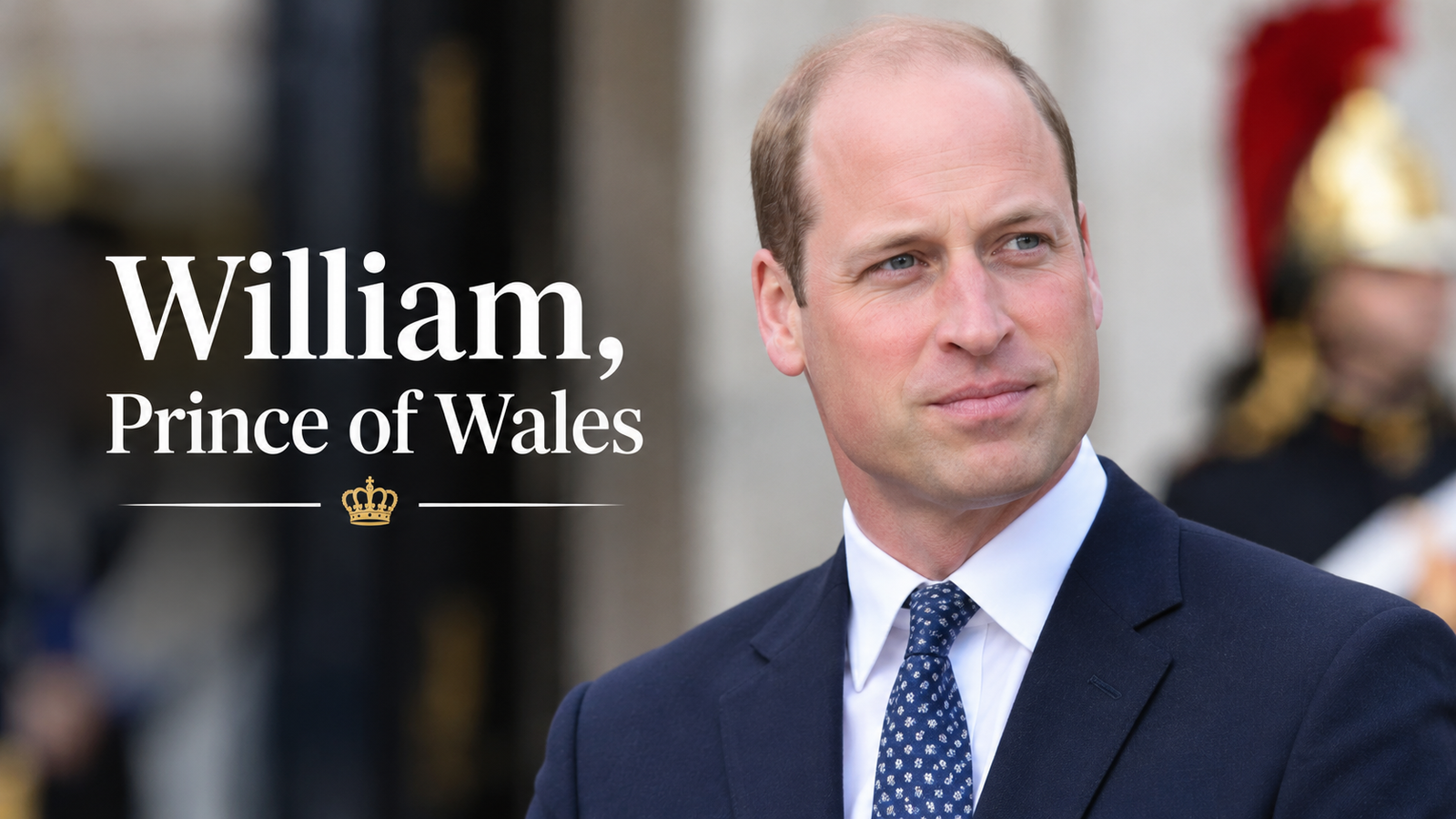
William, Prince of Wales, is one of the most recognised members of the British Royal Family. As the eldest son of King Charles III and the late Diana, Princess of Wales, he holds an important position in the monarchy and is first in line to the British throne. Many people know him from royal ceremonies, public appearances, and news stories about his family, but there is much more to his life than what appears in headlines. His education, military experience, charity work, and personal values have all helped shape the person he is today.
Over the years, Prince William has grown from a young royal who spent much of his childhood under public attention into a senior member of the Royal Family with major responsibilities. He supports his father in official duties, works with charities, and promotes causes such as environmental protection and homelessness. His approach to royal life also reflects a changing public expectation, where people want members of the monarchy to be approachable, responsible, and connected to the issues affecting everyday communities.
In this article, we will explore the life of William, Prince of Wales, including his early years, education, marriage to Catherine, Princess of Wales, their children, and his work as a future monarch. Whether you are researching his biography or simply want to understand his role in the modern British monarchy, this guide covers the main details in a straightforward and engaging way.
Who Is William, Prince of Wales?
William Arthur Philip Louis was born on 21 June 1982 at St Mary’s Hospital in Paddington, London. He is the elder son of King Charles III and Diana, Princess of Wales, and the older brother of Prince Harry, Duke of Sussex. From birth, his position in the Royal Family placed him in the public eye, although his parents also tried to give him experiences that would help him understand life beyond royal palaces and official ceremonies.
Prince William became the Prince of Wales in September 2022, following the accession of his father as king after the death of Queen Elizabeth II. Before that, he was widely known as the Duke of Cambridge, a title he received on his wedding day in 2011. His new position brought greater responsibility because he became the direct heir to the throne, expected to support the monarch and prepare for a possible future reign.
Being the Prince of Wales is not simply about wearing formal clothing and attending grand events. The role involves representing the King, visiting communities, supporting charities, and helping maintain public interest in the work of the monarchy. William’s responsibilities also require him to balance his official duties with family life, something that has become an important part of how he presents himself to the public. <Cite refs={[“turn536713search0″,”turn536713search3”]}/>
Early Life and Childhood
Prince William spent his early childhood in a world that combined royal tradition with his parents’ efforts to provide a more ordinary upbringing. His mother, Diana, was especially known for taking her children into different environments and introducing them to people from many backgrounds. These experiences helped William see that life outside royal circles could be very different, even though his own childhood was never entirely private.
His childhood was also shaped by the intense media attention surrounding the Royal Family. Photographers and journalists often followed his parents, and William grew up knowing that public interest in his family could sometimes become overwhelming. His parents’ separation and the later divorce of Charles and Diana brought additional changes to family life, making the early years of his life more complicated than the glamorous image of royalty might suggest.
One of the most difficult moments came in August 1997, when Diana died in a car crash in Paris. William was only 15 years old, and he and his younger brother Harry had to cope with a deeply personal loss while the world watched. The funeral became a major public event, but behind the ceremony was a family dealing with grief. This experience has remained an important part of William’s personal story and has influenced how he speaks about family, mental wellbeing, and the importance of support during difficult periods. <Cite refs={[“turn536713search3″,”turn536713search0”]}/>
Education and University Life
William attended several schools during his childhood, including Ludgrove School in Berkshire and Eton College, one of Britain’s best-known independent schools. At Eton, he studied subjects including geography, biology, and history of art. His education was designed to prepare him for a broad range of responsibilities, but he also took part in ordinary school activities and sports like many other students his age.
After finishing school in 2000, William took a gap year. During this period, he travelled and participated in activities in places including Chile, Belize, and Africa. Some of these experiences involved volunteering and learning about communities outside Britain. A gap year can be a valuable time for young people to develop independence, and William’s travels gave him opportunities to learn about different environments and ways of life before moving on to university.
In 2001, he began studying at the University of St Andrews in Scotland. He initially studied history of art before changing his main subject to geography, eventually graduating in 2005 with a Master of Arts degree with upper second-class honours. St Andrews is also significant in his personal life because it was where he met Catherine Middleton, who later became his wife. His university years were an important chapter because they offered him a degree of student life away from the constant formality of royal engagements. <Cite refs={[“turn536713search0″,”turn536713search1”]}/>
William, Prince of Wales, and Catherine, Princess of Wales
William met Catherine Middleton while they were both students at the University of St Andrews. Their relationship developed over time, and they became one of the most widely followed couples in Britain. Although their romance attracted considerable media interest, they did not immediately announce every detail of their relationship. Like many couples, they needed time to get to know each other before deciding what their future might look like.
In November 2010, their engagement was officially announced, and the couple married on 29 April 2011 at Westminster Abbey in London. The wedding attracted a huge global audience and became one of the defining royal events of that period. After their marriage, Queen Elizabeth II gave William the title Duke of Cambridge, while Catherine became the Duchess of Cambridge. Their titles later changed when William became Prince of Wales and Catherine became the Princess of Wales.
Today, William and Catherine work together on a range of royal duties and charitable initiatives. Their public roles are not identical, as each has individual patronages and interests, but they often support shared causes and attend official events as a couple. They have also spoken about the importance of family and giving their children a stable upbringing despite the public nature of their lives. Their partnership has become a central part of the modern Royal Family’s public image. <Cite refs={[“turn536713search0″,”turn536713search5”]}/>
Prince William’s Children and Family Life
William and Catherine have three children: Prince George, Princess Charlotte, and Prince Louis. George was born in July 2013, Charlotte in May 2015, and Louis in April 2018. As the children of the heir to the throne, they have an important place in the future of the monarchy, but their parents have also tried to allow them to experience childhood without every moment becoming a public event.
Parenting can be challenging for any family, and being a senior royal adds a different level of pressure. William and Catherine have to manage official engagements, travel, public expectations, and the everyday needs of their children. They have made efforts to keep family time important, and they sometimes share carefully chosen photographs or updates with the public. This gives people a glimpse of their family while allowing many details to remain private.
Prince George, as the eldest child, is second in line to the throne after his father. Princess Charlotte and Prince Louis also have constitutional places in the succession, although their future roles will depend on their own choices and the responsibilities they take on as they grow older. William’s experience as a child of the monarchy may influence how he and Catherine guide their children. He understands better than most what it means to grow up under public attention, and that could help him make thoughtful decisions about their upbringing. <Cite refs={[“turn536713search0″,”turn536713search3”]}/>
Military Career and Public Service
Before taking on a larger share of royal duties, William completed military training at the Royal Military Academy Sandhurst. He was commissioned as an army officer in December 2006 and served with the Household Cavalry, known as the Blues and Royals. His military experience gave him a closer understanding of the armed forces and the responsibilities associated with service, discipline, and teamwork.
William later trained as a search-and-rescue pilot with the Royal Air Force. Based at RAF Valley in Anglesey, he took part in operational work that involved helping people in emergencies. This experience was different from attending formal royal events because it required technical training, teamwork, and quick decisions in difficult situations. It also gave him a practical view of the people who work in emergency services and the pressures they can face.
After his military service, William worked as a pilot with the East Anglian Air Ambulance from 2015 to 2017. He donated his salary to charity, and his work in the air ambulance service became an important part of his public biography. The experience helped connect his public role with practical service to others. Although his later royal duties became more extensive, his time in the military and emergency services remains a notable part of his background. <Cite refs={[“turn536713search1″,”turn536713search3”]}/>
Charity Work and Causes Supported by Prince William
Charity work is a major part of William’s responsibilities as Prince of Wales. Rather than focusing only on ceremonial duties, he uses his public position to highlight social and environmental issues. He has supported organisations working with young people experiencing homelessness, mental health initiatives, wildlife conservation, and services for people who have served in the armed forces. Royal patronage can bring attention to these organisations and help their work reach a wider audience.
One of William’s major initiatives is Homewards, launched in 2023 through The Royal Foundation. The programme aims to demonstrate that homelessness can be prevented and made rare, brief, and unrepeated through local cooperation. Instead of treating homelessness as a problem that one organisation can solve alone, the programme brings together different groups to work on practical solutions. It reflects William’s interest in long-term approaches rather than simply raising awareness for a short period.
William has also been involved in mental health campaigns, including Heads Together, which encouraged people to speak more openly about mental health challenges. The campaign worked with several charity partners and aimed to reduce the stigma that can stop people from asking for help. His involvement in these causes suggests that he sees the role of a royal as more than attending events: it can also be about bringing public attention to issues that affect real lives. <Cite refs={[“turn536713search0″,”turn536713search2”]}/>
The Earthshot Prize and Environmental Protection
Environmental protection is another key area of William’s work. In 2020, he launched the Earthshot Prize, an initiative designed to identify and support solutions to some of the world’s major environmental challenges. The prize focuses on ideas that could help repair and protect the natural world, including efforts involving clean energy, nature conservation, waste reduction, and the protection of oceans and air quality.
The Earthshot Prize is intended to encourage practical innovation rather than simply discuss environmental problems. Its approach is to recognise ideas that have the potential to grow and make a wider difference. Environmental challenges can feel enormous, and individual people may sometimes wonder whether their choices matter. By highlighting projects and innovators, the prize tries to show that new solutions are possible when science, business, communities, and governments work together.
William has also supported conservation work through initiatives such as United for Wildlife, which was founded with The Royal Foundation in 2014. This work seeks to improve cooperation against illegal wildlife trafficking by bringing together organisations in sectors such as transport, finance, law enforcement, and conservation. These issues are complicated and cannot be solved overnight, but long-term collaboration is important. William’s environmental work has therefore become one of the defining elements of his public role. <Cite refs={[“turn536713search0″,”turn536713search4”]}/>
What Does the Prince of Wales Actually Do?
The title Prince of Wales is traditionally associated with the heir to the British throne. It has a long history and has been held by different heirs over many centuries. William received the title after his father became king in 2022, marking a major change in his official responsibilities. The title itself does not give him the powers of a monarch, but it signals his position as the person expected to succeed King Charles III.
In practice, William supports the King by attending public events, meeting community organisations, carrying out charitable work, and representing the Royal Family in Britain and overseas when required. He also participates in important ceremonies, including commemorations and events recognising public service. Some duties are highly formal, while others involve speaking with people who are doing work in their communities. Both types of engagement form part of the monarchy’s public-facing role.
It is also important to understand that Britain is a constitutional monarchy. The country is governed by elected representatives, and members of the Royal Family do not make government policy simply because of their royal titles. William’s role is largely constitutional, ceremonial, charitable, and representative. His influence often comes through public attention, advocacy, and the ability to bring organisations and communities together rather than through direct political authority. <Cite refs={[“turn536713search4″,”turn536713search0”]}/>
William’s Future as King
As heir to the throne, William is expected to become king after King Charles III, according to the rules of succession. However, the timing of that change is not something that can be predicted, and the current monarch remains the King. William’s present responsibility is to support the monarchy, prepare for the future, and carry out the duties assigned to him while continuing his own charitable and family commitments.
The monarchy has changed significantly over time, and future generations may expect it to be more transparent, relevant, and connected to everyday life. William’s public work suggests that he wants to focus on issues such as homelessness, environmental protection, mental health, and community support. Whether these efforts lead to lasting change will depend on the work of many people and organisations, not just on one royal figure. Still, his position allows him to draw attention to problems that might otherwise receive less public discussion.
William’s experience also gives him a different perspective from previous generations. He has worked in emergency services, experienced intense media attention from childhood, and raised children while carrying out public duties. These experiences may influence the kind of monarch he becomes, although it is too early to know exactly what his reign would look like. The future will depend on the challenges Britain faces and the choices William makes when his responsibilities eventually change.
Interesting Facts About William, Prince of Wales
One interesting fact is that William studied geography at university, rather than choosing a subject directly connected to royal history or politics. His degree included an interest in the natural world, which connects in some ways with his later environmental initiatives. His academic background does not explain every part of his work, but it is a reminder that he developed interests beyond royal protocol and public ceremonies.
Another notable detail is his experience as a search-and-rescue and air ambulance pilot. Many people know him mainly from royal appearances, but these roles required specialised training and practical responsibility. They exposed him to the work of emergency teams and to situations where people needed help quickly. This is a different side of his biography that can be overlooked when media coverage focuses mainly on his clothes, family photographs, or ceremonial appearances.
William is also known for his interest in sport and his support for charitable and community organisations. Through royal patronages, he can help raise awareness of the work carried out by charities, sports groups, and conservation organisations. While public attention often concentrates on royal titles and family news, these activities make up a large part of his official schedule. They show how a modern royal can use public visibility to support causes and encourage wider participation. <Cite refs={[“turn536713search0″,”turn536713search3”]}/>
Frequently Asked Questions About William, Prince of Wales
When was William, Prince of Wales, born? He was born on 21 June 1982 at St Mary’s Hospital in Paddington, London. He is the eldest son of King Charles III and Diana, Princess of Wales.
Who is William, Prince of Wales, married to? He is married to Catherine, Princess of Wales, formerly known as Catherine Middleton. They married at Westminster Abbey on 29 April 2011.
How many children does Prince William have? William and Catherine have three children: Prince George, Princess Charlotte, and Prince Louis. George is currently second in line to the British throne after his father.
Why is William called the Prince of Wales? King Charles III gave William the title after becoming king in September 2022. The title is traditionally associated with the heir to the British throne, although it does not make William the monarch.
What charities and causes does Prince William support? His work includes homelessness prevention through Homewards, environmental action through the Earthshot Prize, wildlife conservation, and mental health awareness. He also supports a range of other charities and organisations through royal patronages.
Final Thoughts
William, Prince of Wales, has a life shaped by royal tradition, personal experiences, family responsibilities, and public service. From his childhood and education to his military career and work with charities, he has developed a role that goes well beyond ceremonial appearances. As the heir to the British throne, he must balance the expectations that come with his title with the changing needs of the society he represents.
His family life with Catherine and their three children is also an important part of his public identity. Having experienced the loss of his mother and the pressure of growing up in the spotlight, William understands some of the challenges that can come with royal life. He and Catherine have tried to give their children a supportive upbringing while continuing to carry out official responsibilities.
Looking ahead, William’s work on homelessness, environmental protection, and mental health may continue to shape his public priorities. He has not yet become king, and the exact nature of his future reign cannot be known in advance. For now, he remains a senior royal supporting King Charles III and preparing for the role that may one day be his. His story is still developing, and that is what makes William, Prince of Wales, such an interesting figure in the modern monarchy.
You May Also Read : Latest Category MeltingTopGames


One thought on “William, Prince of Wales: Biography, Family, Education, Royal Duties, and Future as King”