
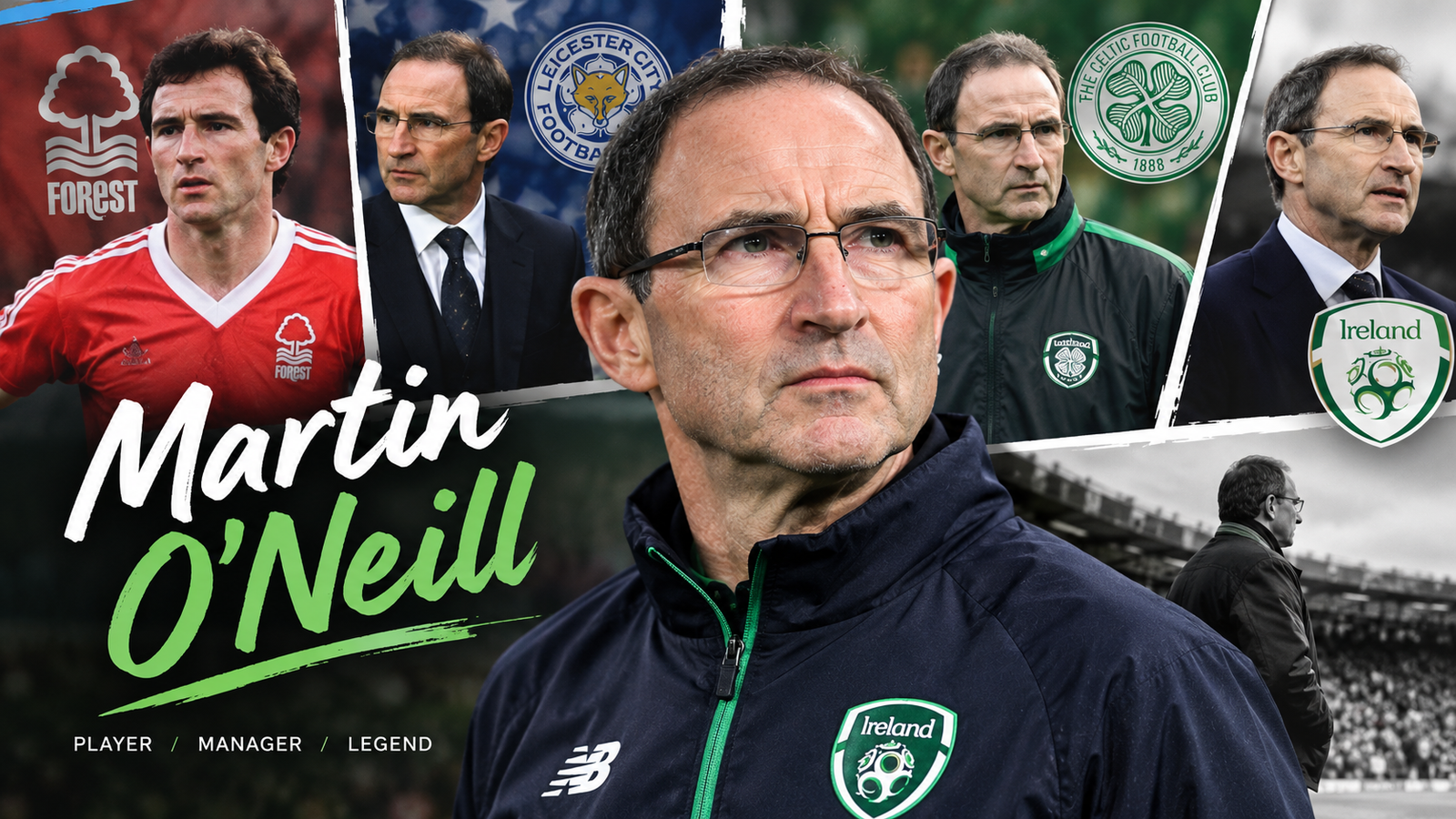
Who Is Martin O’Neill?
Martin O’Neill is one of the most respected names in British and Irish football, known for his strong personality, tactical understanding, and ability to bring the best out of his players. Born on 1 March 1952 in Kilrea, Northern Ireland, Martin Hugh Michael O’Neill built a remarkable career as both a professional footballer and a manager. Over the years, he has worked with several well-known clubs, including Nottingham Forest, Leicester City, Celtic, Aston Villa, and Sunderland. His journey is interesting because he experienced the game from both sides, first as a player on the pitch and later as the person making the big decisions from the touchline.
What makes O’Neill different from many other managers is his old-school approach mixed with a sharp understanding of modern football. He is known for being passionate, demanding, and direct when discussing his team. Supporters often appreciate managers who show genuine emotion, and O’Neill has never been someone who hides his feelings during an important match. His teams have frequently been associated with hard work, discipline, and a strong competitive spirit, qualities that helped him become a popular figure at several clubs.
As of 2026, O’Neill is back in charge of Celtic, one of Scotland’s biggest football clubs. Celtic officially confirmed his appointment on a one-year contract, with an option for another year, on 11 June 2026. His return followed an impressive period in which he helped the club win domestic silverware, including the Scottish Premiership and Scottish Cup in the 2025–26 season. His story shows how experience, confidence, and a deep understanding of football can keep a manager relevant even after decades in the sport.
Martin O’Neill’s Early Life and Football Beginnings
Martin O’Neill grew up in Kilrea, a village in County Londonderry, Northern Ireland. Football became an important part of his life at an early age, although his sporting interests were not limited to association football. He also played Gaelic football during his younger years, which is a major part of sporting culture in Ireland. This early experience helped him develop a competitive attitude and a strong connection with local sport. For O’Neill, football wasn’t just a career choice; it was something that gradually became central to his life.
Before becoming a familiar name in English football, O’Neill played for local side Distillery in Northern Ireland. His performances helped him attract attention, and a move to Nottingham Forest in 1971 proved to be a major turning point. At the time, joining an English club offered him a chance to test himself at a higher level and compete against some talented players. Leaving familiar surroundings for a new football environment was a big step, but it gave him the opportunity to build the career that would later shape his reputation as a manager.
Interestingly, O’Neill also studied law at Queen’s University Belfast before committing himself fully to professional football. That detail gives a little insight into his personality, because his interests were not limited to sport alone. His education and wider experiences may have helped him develop the analytical side that became visible during his management career. Footballers are often judged only by their performances on the pitch, but O’Neill’s background suggests he had a broader range of interests from the beginning. His early years helped shape a person who could understand both the emotional and strategic sides of the game.
Martin O’Neill’s Playing Career at Nottingham Forest
Nottingham Forest played a major role in Martin O’Neill’s development as a footballer. He joined the club in 1971 and spent much of his playing career there, becoming part of a team that enjoyed extraordinary success under manager Brian Clough. Forest rose to the top of English football during the late 1970s, winning the First Division title in the 1977–78 season before lifting the European Cup in 1979 and again in 1980. O’Neill was part of that successful era, and those experiences gave him a close look at what it takes to build a winning team.
Playing under Brian Clough was an important part of O’Neill’s football education. Clough was famous for his confidence, strong leadership, and ability to motivate players, and his teams often performed beyond what outsiders expected. O’Neill experienced the pressure of competing at the highest level and learned what a demanding dressing room could look like. Those lessons would later become valuable when he took charge of his own teams. Success at that level is rarely accidental; it comes from preparation, trust, tactical awareness, and players who understand their roles.
After leaving Nottingham Forest, O’Neill continued playing for clubs including Norwich City, Manchester City, and Notts County. He also represented Northern Ireland internationally, earning 64 caps and captaining the national team at the 1982 FIFA World Cup in Spain. Representing his country on football’s biggest stage was a significant achievement and gave him further experience of high-pressure competition. His playing career wasn’t simply a stepping stone to management; it provided the practical knowledge that later helped him relate to footballers and understand what they need from a coach.
How Martin O’Neill Became a Successful Football Manager
After finishing his playing career, Martin O’Neill moved into management, beginning with Grantham Town in 1987. Starting with a smaller club gave him the opportunity to learn the job without the enormous attention that comes with managing a major team. Managing football is very different from playing it, because a coach has to deal with tactics, squad selection, player confidence, training, and the expectations of supporters. O’Neill gradually developed his own style, relying on organisation, motivation, and the ability to make his players believe they could compete with stronger opponents.
His work with Wycombe Wanderers helped establish him as a promising manager. During his time there, the club achieved success in non-league football and won the FA Trophy in 1991 and 1993. These results helped O’Neill build a reputation for improving teams and getting results with the resources available to him. Not every manager gets the opportunity to begin at a famous club, and O’Neill’s rise through the lower levels gave him valuable experience. He learned to deal with different expectations and the practical challenges that come with building a competitive squad.
O’Neill later managed Norwich City before taking charge of Leicester City in 1995. Leicester became one of the most successful periods of his career, as he guided the club to two League Cup victories, in 1997 and 2000, and established them as a competitive side in English football. His teams were not always the most expensive or technically glamorous, but they were difficult to beat and usually approached matches with clear purpose. Leicester supporters remember that era fondly because the club achieved major results while competing against wealthier opponents. This stage of his career helped make O’Neill a serious candidate for bigger managerial jobs.
Martin O’Neill’s Famous Years at Celtic
Martin O’Neill’s appointment at Celtic in 2000 marked the beginning of one of the most memorable chapters in his managerial career. Celtic had a huge following and a history of success, but the expectations were intense because of the club’s rivalry with Rangers. O’Neill arrived with the task of building a team capable of winning trophies and competing consistently. His impact was immediate, as Celtic won the Scottish domestic treble in his first season, securing the league title, Scottish Cup, and Scottish League Cup. For supporters, it was a statement that the club was ready to challenge for honours again.
During his first spell at Celtic, from 2000 to 2005, O’Neill won multiple domestic trophies and built a team that could compete strongly in Europe. Players such as Henrik Larsson became central to the side, while the squad developed a reputation for physical strength, attacking quality, and a never-give-up attitude. O’Neill understood the importance of giving talented players clear responsibilities while creating a strong team identity. His Celtic side was not perfect every week, of course, but it regularly delivered memorable performances and gave fans plenty of reasons to believe.
One of the biggest highlights came in 2003, when Celtic reached the UEFA Cup final in Seville. They eventually lost to Porto after extra time, but the European run remains a special memory for many supporters. Reaching a major European final was a huge achievement and demonstrated that Celtic could compete against leading continental sides. O’Neill’s first Celtic period established a lasting connection between him and the club. His later return was therefore more than a managerial appointment; it brought back a familiar figure whose previous success had earned him considerable respect among the supporters.
Martin O’Neill at Aston Villa and Other Clubs
After leaving Celtic in 2005, O’Neill eventually took charge of Aston Villa in 2006. Villa were looking to establish themselves among the stronger clubs in the English Premier League, and O’Neill helped them make significant progress. During his time in charge, the club achieved three consecutive sixth-place league finishes between 2007 and 2010. That consistency was important because the Premier League is extremely competitive, with clubs spending heavily in the hope of securing European qualification. Villa under O’Neill became a difficult opponent, and their performances suggested the club could challenge the established teams.
O’Neill’s time at Villa also included a run to the 2010 League Cup final, although the team did not win the trophy. His management style continued to focus on commitment, organisation, and getting the maximum out of his squad. At times, his approach was criticised for being too direct or for relying heavily on certain players, but no manager is free from debate. What matters is that Villa were competitive for much of his tenure, and he helped create a team that supporters could be proud of. The period also demonstrated the difficulties managers face when results, budgets, and long-term planning do not always line up.
Later, O’Neill managed Sunderland and Nottingham Forest, while also taking on a major international role with the Republic of Ireland. His time at Sunderland came with the usual pressures of Premier League football, where a poor run of results can quickly become a serious problem. His spell at Nottingham Forest in 2019 was much shorter. These experiences showed that even a manager with a strong record can face challenges when circumstances change. Football management is unpredictable, and previous success never guarantees that a new job will work out exactly as planned.
Martin O’Neill and the Republic of Ireland National Team
Martin O’Neill became manager of the Republic of Ireland national team in 2013, taking on a different challenge from club football. International management gives a coach less time with players, making preparation and communication especially important. Rather than working with a squad every day throughout a long league season, national-team managers must build a competitive group around short training camps and scheduled matches. O’Neill had to adapt his methods while working with players who represented different clubs and played under different tactical systems.
One of the biggest achievements of his time with Ireland was guiding the team to qualification for UEFA Euro 2016. It was a memorable accomplishment for Irish football, particularly because qualification meant the team could compete on a major European stage. Ireland also produced a notable result by beating Italy during the tournament’s group stage, securing a place in the knockout rounds. These moments showed how a well-organised team can cause problems for opponents with greater resources and more individual star power.
O’Neill’s Ireland tenure lasted until 2018, when he and the Football Association of Ireland agreed to part ways. His time with the national team included both exciting achievements and difficult periods, as international football often does. Qualification campaigns can be decided by a single goal or one unexpected result, so consistency is not always easy to maintain. Nevertheless, leading Ireland to Euro 2016 remains one of the standout achievements of his career and added another important chapter to his long history in football.
Martin O’Neill’s Return to Celtic in 2025 and 2026
O’Neill’s relationship with Celtic became relevant again in late 2025, when he returned to the club as interim manager. The circumstances were challenging, with the club needing stability and strong performances. His familiarity with Celtic, combined with decades of managerial experience, made him a recognisable figure who could help restore confidence. Returning to a club after many years can be difficult because football changes quickly, but his understanding of the club’s culture was a useful advantage.
After an initial interim spell, O’Neill stepped aside as the club moved in a different direction. He returned to the role in January 2026 following a difficult period for Celtic under Wilfried Nancy. O’Neill then helped guide the team through a strong finish to the season, winning the Scottish Premiership and Scottish Cup. According to Reuters, his team won the final eight domestic matches of his interim spell in late 2025, and his later return helped Celtic secure another successful campaign. These results strengthened the case for giving him the job permanently.
Celtic officially confirmed O’Neill as manager on 11 June 2026, signing him to a one-year contract with an option for another year. The appointment underlined the club’s confidence in his experience and ability to handle pressure. Still, the next challenge is never easy: football supporters expect more success once a team has won trophies, and European competition brings its own demands. O’Neill will need to keep the squad motivated, manage player fitness, and help Celtic remain competitive at home and abroad. His latest chapter is a reminder that experienced managers can still make a major impact when the right opportunity arrives.
Martin O’Neill’s Management Style and Personality
Martin O’Neill is often described as a passionate manager who expects commitment from his players. He values discipline, hard work, and a strong sense of responsibility, while also understanding the importance of confidence in football. Players need to know what is expected of them, especially when matches become difficult, and O’Neill has generally been comfortable making his expectations clear. His touchline reactions and press-conference comments have sometimes attracted attention, but they also reflect his intense involvement in the game.
Tactically, O’Neill’s teams have often been organised, competitive, and prepared to work hard without the ball. He has traditionally favoured a practical approach, focusing on the strengths of his available players rather than trying to copy every new tactical trend. Modern football places greater emphasis on detailed data, pressing structures, and sophisticated build-up play, so experienced managers have to keep adapting. O’Neill’s long career shows that football knowledge is valuable, but successful management also depends on responding to changing opponents, player expectations, and the demands of the club.
His personality has played a big part in the way supporters view him. Some fans appreciate his directness and old-school character, while others may prefer a calmer style of communication. That difference of opinion is normal in football, where every decision is examined closely. O’Neill’s strongest quality may be his ability to create belief during difficult periods and make players understand the importance of competing as a team. Results will always matter, but a manager’s influence on confidence and mentality can be just as important over a long season.
Martin O’Neill’s Personal Life and Interests
Although Martin O’Neill is widely recognised for his football career, he has generally kept his personal life away from the centre of public attention. He is married to Geraldine, and the couple have children. Unlike some figures in modern football who share large parts of their private lives on social media, O’Neill has largely maintained a more private approach. This has allowed the focus to remain on his work as a player and manager rather than on constant personal headlines.
O’Neill’s background in Northern Ireland and his early involvement in Gaelic football are also important parts of his story. His sporting journey reflects the strong role that local communities and traditional sports can play in shaping a person’s interests. Before professional football became his full-time career, he was involved in education as well, studying law at Queen’s University Belfast. These experiences make his biography more interesting than a simple list of clubs and trophies, because they show the different influences that helped shape his personality.
Away from the touchline, O’Neill has also shared his experiences and opinions through writing. His book The Changing Game, published in 2025, explores the evolution of football, the role of managers, and the pressures surrounding the modern sport. It draws on his experience across several decades, offering readers a perspective shaped by working under Brian Clough and managing clubs at different levels. For fans who want to understand the thinking behind his decisions, his writing offers another way to learn about his approach to the game.
Conclusion: Why Martin O’Neill Remains an Important Football Figure
Martin O’Neill’s career is a reminder that football success is built through a combination of experience, leadership, preparation, and the ability to handle pressure. From winning European Cups as a Nottingham Forest player to lifting domestic trophies with Leicester City and Celtic, he has been involved in some memorable moments. His work with the Republic of Ireland also showed that he could adapt to international football and guide a national team through the challenges of a major tournament. Few managers have experienced so many different sides of the game over such a long period.
His return to Celtic in 2025 and permanent appointment in June 2026 added another surprising chapter to his career. Rather than simply looking back at past achievements, O’Neill has once again been given the responsibility of leading a major club and meeting the expectations that come with it. The challenge now is to build on recent success and keep Celtic competitive as the game continues to change. Whether supporters admire his personality, his trophies, or his ability to motivate players, there is little doubt that he has made a lasting mark on football.
Ultimately, Martin O’Neill is more than just a manager with a list of honours. He is a football figure whose career connects different generations of players, coaches, and supporters. His story includes major victories, difficult spells, unexpected returns, and the kind of experience that can only come from decades in the sport. For anyone interested in British and Irish football, O’Neill remains a fascinating person to follow, and his latest Celtic chapter gives fans another reason to pay attention to what happens next.
You May Also Read : Gina McKee Husband


One thought on “Martin O’Neill: Career, Achievements, Personal Life, and His Journey in Football”